Consumer attention span is shorter than ever and ad platforms keep getting more expensive. For a small team, that's a tough combination: you need to test more creative to find out what works, but testing often means hiring more people, or paying an agency.
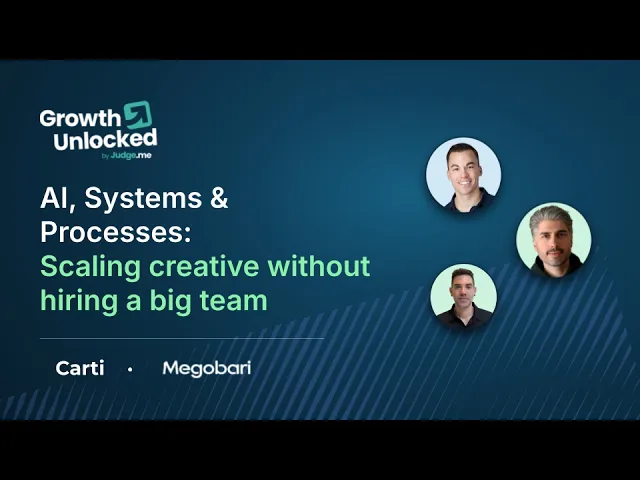
AI has changed this. At Growth Unlocked: The Summit, our Chief Growth Officer Fabrizio Assabese sat down with two operators who've built their whole creative process using AI, and who spend their days in both the DTC and the tech side of Shopify. Ika Lobjanidze runs two DTC brands and an A/B testing app, with six years in the ecosystem. Daniel Anderson has been building on Shopify for over a decade, runs his own brand, and built the AI sales assistant app Carti.
They walked us through their workflows: how a small team can research, create, and test creative at a scale that used to need a department. You can watch the full session below, or read on for the recap.
New to using AI in your store? Our guide to using AI for business covers the fundamentals first.
Start with research, not creative
Ika's first move is customer research, run through AI. He gives the tool a detailed brief about the product, then sends it to read Reddit threads, Amazon reviews, Facebook Marketplace, and other places people talk about products like his. Crucially, he tells it what to look for: he names specific desires to probe, health, safety, comfort, belonging, personal relationships, and has the AI assess the product through each lens, reporting back on why people actually buy.
What comes back is a report on the core problems customers face, the desires behind their purchases, and, most usefully, the exact words they use about the product. He then feeds that research into a persistent AI project, so the tool holds everything it's learned about his customers as context for every step that follows.
That last part matters more than it sounds. The language your customers actually use is the language that works in your ads, and it's rarely the language in your product description. Getting it from real conversations, rather than guessing, is the foundation everything else is built on.
For examples of the exact prompts Ika uses, skip to 9:52 in the session recording above.
Build avatars, then sub-avatars
Once the research is in, the next step is turning it into personas, or avatars, each representing a pocket of customers who buy for different reasons.
Ika walked through a real example: a slipper brand. The AI surfaced broad desires like comfort, belonging, and status, and from there he built sub-avatars underneath each one. "Cold feet people" became people who work from home and get cold feet, people who are naturally cold, people who want warm feet with their morning coffee. "End-of-day comfort seekers" became nurses and teachers who stand all day and want comfort when they get home.
Each sub-avatar is a different reason to buy, and so a different angle to advertise. Ika organizes them in a spreadsheet where each row is one creative concept: avatar, sub-avatar, angle, format. That spreadsheet becomes the brief for everything that follows.
Study the competition to find the gaps
Daniel approaches the same problem from the other side: competitive research, to find what he calls the blue ocean, the space competitors aren't fighting over.
The point isn't to copy competitors, it's to see where they're all crowding so you can go somewhere they aren't. If every slipper brand is targeting cold feet, that's a competitive space; if nobody's talking about the evening ritual angle, that gap could be yours to claim.
To see what competitors are actually running, he starts with the free ad libraries: the Meta Ads Library first, then Google Ads Transparency, then TikTok's equivalent. Each lets you search a brand and see every ad it's running, so you can tell at a glance whether a niche leans on product shots, lifestyle images, or video. You can do this by hand, and it's not a bad place to start. You can also ask ChatGPT or Claude to work through a list of competitors and pull everything into one swipe file, which becomes the raw material for the next step. Daniel finds Claude stronger at this parsing task; your own preference may differ.
For deeper competitive intelligence, he and Ika also pointed to paid tools like TrendTrack, which shows competitors' ad spend, the ads they're running, and the landing pages they point to, useful if you want to study the best-performing brands in your space.
The prompting shortcut that actually works
Early on, there was a lot of pressure to write one perfect, elaborate prompt. Both operators have moved past that, and the shortcut is simple: instead of trying to think of everything yourself, ask the AI to ask you the questions.
Tell it what you're trying to do and have it interview you first: what's missing, what haven't you considered? Answer its questions, and it builds the prompt from your answers, filling the gaps you didn't know were there. You end up with something far better than you'd have written cold.
We covered more of this in our guide to using AI for business.
Generate, then use your own judgment
With the concepts mapped, Ika feeds a batch of rows back into ChatGPT to generate the actual ad images, dozens at a time, in seconds.
Two disciplines keep this from going wrong. First, never ship raw AI output. Whatever the tool gives back, sense-check it and add your own judgment before anything goes live. Second, train the tool over time rather than expecting it to be right immediately. Ika compares it to training a dog: feed your project real product photos from different angles, your fonts, your colors, your brand guide, so the output stays consistent and recognizably yours. When it drifts, adding a stray CTA or an invented slogan, you correct it, lock in what works, and have it repeat that.
Daniel builds on the same idea with agents: within a project, he creates specialized agents for specific jobs, one as a copywriter, one as a designer, the way you'd build a team rather than asking one person to do everything. Each gets refined over a week or two of back-and-forth until it produces something consistent every time.
One honest limitation both raised: AI still struggles with realistic faces and hands. The workaround is simple, favor waist-down shots or object-only images, where the result is indistinguishable from a studio photo.
The point is speed of testing, not the final ad
This is the reframe that makes the whole thing work, and it's easy to miss.
The AI-generated ads aren't the finished product. Some look like AI, and that's fine. The point isn't to produce the one perfect creative; it's to test many ideas fast. You can push 50 different concepts into Meta at once and see which angles the market responds to, something that used to take days of a designer's time and manual uploading, now done in minutes.
With the slipper brand, that testing surfaced something they wouldn't have guessed: "cold floors," specifically, was the angle that drove spend, out of all the cold-feet variations. Once they knew that, they invested properly, ordering UGC videos and photoshoots built around cold floors. The AI didn't make the final winning creative. It found the winning angle, cheaply, so the real production budget went to a proven idea rather than a hunch.
That's the model: use AI to test broadly and cheaply, then put real money behind what the data picks.
Launch and measure at scale
Generating 50 concepts is only useful if you can launch them without 50 manual uploads. Ika uses bulk-launch tools like AdManage to import hundreds of creatives at once and launch ads or ad sets in a click, so the management keeps pace with the creation.
Reading the results depends on your budget. The ideal signal is return on ad spend, how much revenue each dollar generates, or better, profit per ad spend. But many smaller stores don't have enough spend for clean ROAS numbers, and here Ika offered a practical fallback: on broad targeting, watch where Meta's algorithm chooses to put your budget. Meta allocates spend to the ads doing the real work, even ones that aren't driving the final click, so trusting that allocation is a reasonable signal when conversions are too sparse to read.
The overall shape: start very broad, with many avatars and angles, then narrow down hard on the winners, building more variations around what's already working.
Does AI creative hurt your credibility?
It's the question everyone asks, and the honest answer is: it depends, but less than you'd think.
For roughly 90 to 95% of brands, Daniel's view is that AI creative is a non-issue. Most shoppers can't tell, and the technology is only getting harder to spot. A protein bar shot with nutrition facts could be AI or Photoshop; nobody could say which. The exceptions are brands whose customers hold an ideological objection to AI, in some cases strong enough that a few brands now make "we don't use AI" an explicit positioning choice. If that's your niche, leaning into it can be the right call.
And there's a middle path, which matters for anyone in an AI-skeptical category. You can use AI internally, for research, for process, for first-draft inspiration, without the visible, finished work being AI-generated. Daniel's team includes graphic designers whose process often begins with AI for inspiration but doesn't end there; the final design is theirs. As Ika put it, your customers' objection is usually about replacing human creativity, not about you running better internal research. Used that way, AI speeds the work without touching what the customer sees.
Where this starts, and where Judge.me fits
Notice what the entire workflow is built on: knowing the exact language your customers use. The operators scrape Reddit and Amazon to find it. If you're on Judge.me, you're already sitting on a cleaner source of the same thing, your own reviews.
Every review is a customer describing your product in their own words, and Judge.me's AI sentiment and topic analysis pulls out the themes and language they keep returning to. That's customer research you don't have to go looking for, and it feeds straight into the process above, the avatars, the angles, the copy. It's the same principle that makes reviews worth collecting in the first place: your customers have already told you what matters to them.
If you want the fundamentals of using AI across your store, start with our guide to using AI for business. And you can see how Judge.me's own AI review features work on our AI review features page.
Frequently asked questions
Can a small team really produce ad creative at scale with AI?
Yes, and that's the main point. AI lets a small team test dozens of creative concepts in the time it used to take to make one or two, by generating variations quickly and cheaply. The goal isn't a finished ad but a fast, affordable way to find which angles work before investing in proper production.
Will AI-generated ads put customers off?
For most brands, no. Most shoppers can't tell AI creative from conventionally produced creative, especially for product shots, and it's getting harder to spot. The exception is brands whose customers specifically object to AI, where using it only internally (for research and drafts) is the safer path.
What's the best way to prompt AI for creative work?
Rather than writing a long, perfect prompt, ask the AI to interview you first: tell it your goal and have it ask what it needs to know, then have it write the prompt from your answers. It fills the gaps you'd have missed.
How do I know which ad is working if I have a small budget?
Return on ad spend is the clearest signal, but it needs enough volume to be reliable. On a smaller budget, watch where Meta's algorithm allocates your spend on broad targeting; it tends to favor the ads doing the real work, even before conversions are clear.